January 25, 2006

Working on Machiavelli

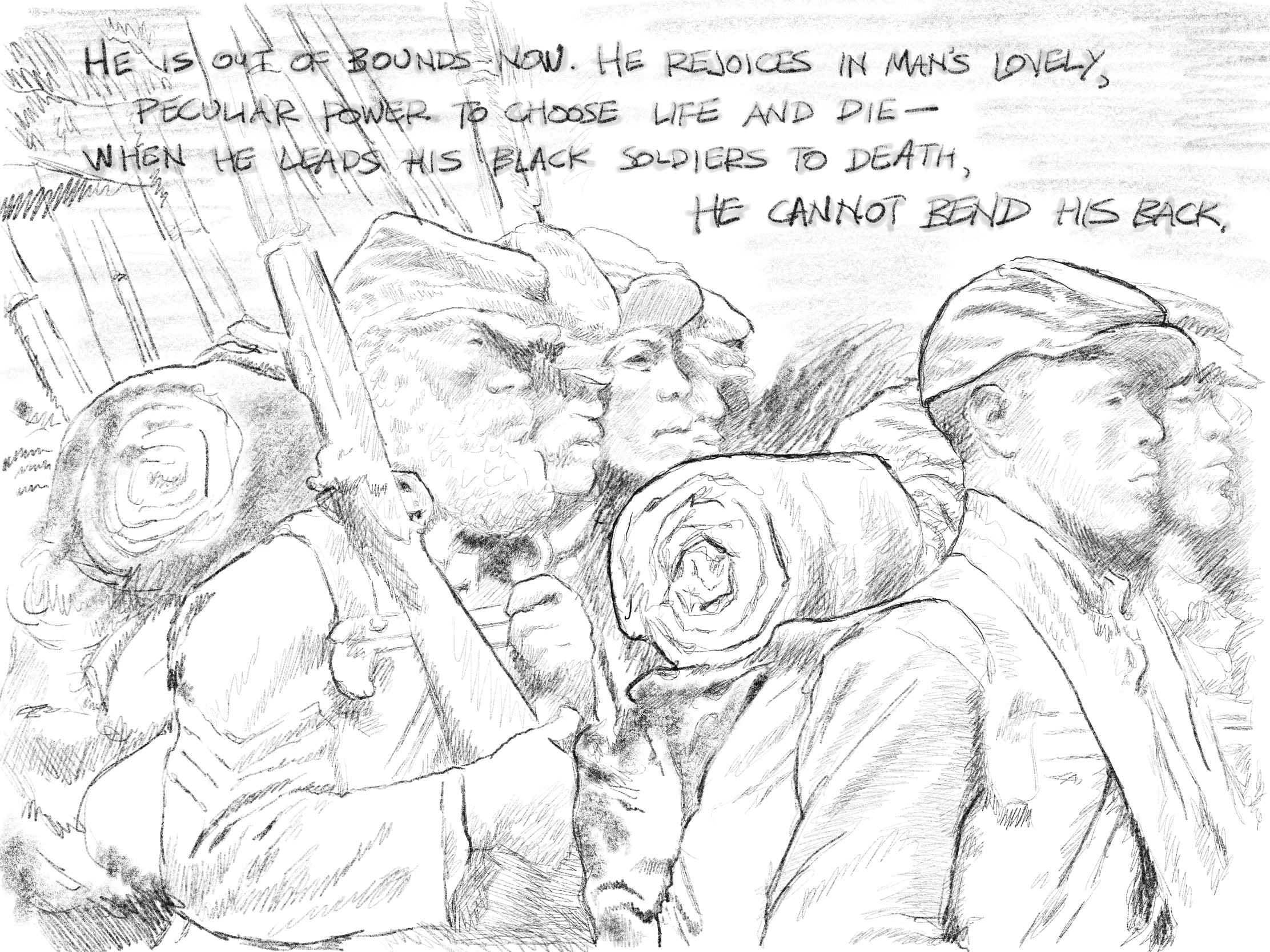
No, the web site has not been orphaned. I really haven't had any time to dedicate to it because all my time is occupied with work on Machiavelli. The site will get a major overhaul when the book is out of my hands and in production (mar-apr 2007.) At that time, I'll be updating the gallery, adding ordering info, and posting regular updates. If you are visiting the site in the interim, just form a mental image of me hunched over the drawing table, because that's what's going on right now.

September 11, 2005

SPX 2005

I will be exhibiting at this year's SPX. For those attending, I will be giving out minicomics: an exerpt from chapter two. I still have a number of the chapter one minicomics from SPX 2004, so if you stop by my table you can really stock up on free stuff. The chapter one excerpts are a little outdated, as I've revised a few pages (and completely redrawn one or two) from that chapter in the year since I made those minis. I hope I see you there!

June 29, 2005

Joe Sacco

Mother Jones has an interesting interview with journalist-cartoonist Joe Sacco. In it, he briefly talks about creating comics based on past events.

Mother Jones: When you’re re-creating events you haven’t witnessed, do people ever challenge your portrayal of those scenes?

Joe Sacco: I try to ask visual questions. I’ll ask what someone was wearing, if that seems relevant. If possible, I’ll walk over the same ground that they’re depicting. Of course, I can never get it precisely as it was. It’s like a film director trying to represent a scene that took place in the 1700s. You reconstruct it to the best of your ability.

April 08, 2005

Paul Graham's advice

[D]on't get demoralized. Don't think that you can't do what other people can. And I agree you shouldn't underestimate your potential. People who've done great things tend to seem as if they were a race apart. And most biographies only exaggerate this illusion, partly due to the worshipful attitude biographers inevitably sink into, and partly because, knowing how the story ends, they can't help streamlining the plot till it seems like the subject's life was a matter of destiny, the mere unfolding of some innate genius. In fact I suspect if you had the sixteen year old Shakespeare or Einstein in school with you, they'd seem impressive, but not totally unlike your other friends.
Which is an uncomfortable thought. If they were just like us, then they had to work very hard to do what they did. And that's one reason we like to believe in genius. It gives us an excuse for being lazy. If these guys were able to do what they did only because of some magic Shakespeareness or Einsteinness, then it's not our fault if we can't do something as good.
I'm not saying there's no such thing as genius. But if you're trying to choose between two theories and one gives you an excuse for being lazy, the other one is probably right.

...

The best protection is always to be working on hard problems. Writing novels is hard. Reading novels isn't. Hard means worry: if you're not worrying that something you're making will come out badly, or that you won't be able to understand something you're studying, then it isn't hard enough.
...

Now I know a number of people who do great work, and it's the same with all of them. They have little discipline. They're all terrible procrastinators and find it almost impossible to make themselves do anything they're not interested in. One still hasn't sent out his half of the thank-you notes from his wedding, four years ago. Another has 26,000 emails in her inbox.
I'm not saying you can get away with zero self-discipline. You probably need about the amount you need to go running. I'm often reluctant to go running, but once I do, I enjoy it. And if I don't run for several days, I feel ill. It's the same with people who do great things. They know they'll feel bad if they don't work, and they have enough discipline to get themselves to their desks to start working. But once they get started, interest takes over, and discipline is no longer necessary.

http://paulgraham.com/hs.html

January 16, 2005

Machiavelli Teaser

I have been very busy on Machiavelli, to the detriment of the web site. So, for those who did not see the mini, here is a teaser page from chapter one of the book. This should give you an idea of the artistic direction I'm taking the book. Click on the "continue reading" link below to see the entire page.

Continue reading "Machiavelli Teaser"

October 17, 2004

Images of SPX

I travelled to The Small Press Expo (SPX) this year to give away sample chapters of Machiavelli. SPX is an expo/arts festival attended by independent cartoonists, readers, and publishers. I also went in 2002 as an attendee. This year, though, I had a table. I gave away about five hundred sample comics. These mini-comics printed the first chapter of Machiavelli and looked like this:

Continue reading "Images of SPX"

September 16, 2004

Machiavelli to be published by The Vendome Press in 2006

I am extremely pleased to announce that Machiavelli will be published by The Vendome Press in 2006. Vendome is an illustrated book publishing company distributed through Harry N. Abrams, inc. Machiavelli will be their first graphic novel, although because of subject matter and treatment, it fits in well with their current list. We are planning to release the book in spring 2006, in hardcover, with about 160 pages. Previews will be available at SPX (Oct 1-3), please come by my table and pick up a copy of the first chapter.

August 10, 2004

Drawing in the Time of Machiavelli


I've added a couple of new sketches to the Machiavelli site. They are based on drawings by Maso Finiguerra, a near contemporary of Machiavelli's—he died five years before Machiavelli was born.

July 20, 2004

The New York Times on Graphic Novels

Charles McGrath, former editor of the Times' Book Review, has written an informative overview of the art comics movement.

Comics are also enjoying a renaissance and a newfound respectability right now. In fact, the fastest-growing section of your local bookstore these days is apt to be the one devoted to comics and so-called graphic novels. It is the overcrowded space way in the back—next to sci-fi probably, or between New Age and hobbies—and unless your store is staffed by someone unusually devoted, this section is likely to be a mess.… What you're looking for is shelved upside down and sideways sometimes—comic books of another sort, substantial single volumes (as opposed to the slender series installments), often in hard cover, with titles that sound just like the titles of "real" books: Palestine, Persepolis, Blankets (this one tips in at 582 pages, which must make it the longest single-volume comic book ever), David Chelsea in Love, Summer Blonde, The Beauty Supply District, The Boulevard of Broken Dreams. Some of these books have titles that have become familiar from recent movies: Ghost World, American Splendor, Road to Perdition. Others, like Chris Ware's Jimmy Corrigan: The Smartest Kid on Earth (unpaged, but a good inch and a quarter thick) and Daniel Clowes's David Boring, have achieved cult status on many campuses.
These are the graphic novels—the equivalent of "literary novels" in the mainstream publishing world—and they are beginning to be taken seriously by the critical establishment. Jimmy Corrigan even won the 2001 Guardian Prize for best first book, a prize that in other years has gone to authors like Zadie Smith, Jonathan Safran Foer and Philip Gourevitch.

[T]here is something like a critical mass of artists, young and old, uncovering new possibilities in this once-marginal form, and a new generation of readers, perhaps, who have grown up staring at cartoon images on their computer screens and in their video games, not to mention the savvy librarians and teachers who now cater to their interests and short attention spans. The publicity that has spilled over from movies like Ghost World, originally a graphic novel by Dan Clowes, has certainly not hurt. And there is much better distribution of high-end comics now, thanks in part to two enterprising publishers, Drawn and Quarterly in Montreal and Fantagraphics Books in Seattle, which have managed to get their wares into traditional bookstores, not just the comics specialty shops. Some of the better-known graphic novels are published not by comics companies at all but by mainstream publishing houses—by Pantheon, in particular—and have put up mainstream sales numbers. Persepolis, for example, Marjane Satrapi's charming, poignant story, drawn in small black-and-white panels that evoke Persian miniatures, about a young girl growing up in Iran and her family's suffering following the 1979 Islamic revolution, has sold 450,000 copies worldwide so far; Jimmy Corrigan sold 100,000 in hardback, and the newly released paperback is also moving briskly.

Although I must object to the notion that the graphic novel is "a form perfectly suited to our dumbed-down culture," (a throwaway line from early in the piece) the article provides an excellent introduction to the best work being done in North American comics today. The author highlights Spiegelman, (a big influence of mine) Ware, Seth, Sacco, Brown, and a few of our other luminaries. As a friend remarked to me: "if someone bought just the books mentioned in this article, they'd have a damned fine comics library."

July 19, 2004

Eddie Campbell's Graphic Novel Manifesto

There is so much disagreement (among ourselves) and misunderstanding (on the part of the public) around the subject of the graphic novel that it's high time a set of principles were laid down.

1. Graphic novel is a disagreeable term, but we will use it anyway on the understanding that 'graphic' has nothing to do with graphics and that 'novel' does not mean anything to do with 'novel'. (in the same way that 'Impressionism' is not really an applicable term, in fact it was first used as an insult and then adopted in a spirit of defiance.)

2. Since we are not referring to the traditional literary novel, we do not hold that the graphic novel should be of the supposed same dimensions or physical weight. Thus subsidiary terms such as 'novella' and 'novelette' are of no use here and will only serve to confuse onlookers as to our goal (see below), causing them to think we are creating an illustrated version of standard literature when in fact we have bigger fish to fry, that is, we are forging a whole new art which will not be a slave to the arbitrary rules of an old one.

3. Graphic novel signifies a movement rather than a form. Thus we may refer to 'antecedents' of the graphic novel, such as Lynd Ward's woodcut novels but we are not interested in applying the name retroactively.

4. While the graphic novelist regards his various antecedents as geniuses and prophets without whose work he could not have envisioned his own, he does not want to be obliged to stand in line behind William Hogarth's Rake's Progress every time he obtains a piece of publicity for himself or the art in general.

5. Since the term signifies a movement, or an ongoing event, rather than a form, there is nothing to be gained by defining it or 'measuring' it. It is approximately thirty years old, though the concept and name had been bandied about for at least ten years earlier. As it is still growing it will in all probability have changed its nature by this time next year.

6. The goal of the graphic novelist is to take the form of the comic book, which has become an embarrassment, and raise it to a more ambitious and meaningful level. This normally involves expanding its size, but we should avoid getting into arguments about permissible size. If an artist offers a set of short stories as his new graphic novel, (as Eisner did with Contract with God) we should not descend to quibbling. We should only ask whether his new graphic novel is a good or bad set of short stories. If he or she uses characters that appear in another place, such as Jimmy Corrigan's various appearances outside of the core book, or Gilbert Hernadez' etc. or even characters that we do not want to allow into our imaginary 'secret society', we shall not dismiss them on this account. If their book no longer looks anything like comic books we should not quibble as to that either. We should only ask whether it increases the sum total of human wisdom.

7. The term graphic novel shall not be taken to indicate a trade format (such as 'tradepaperback' or 'hardcover' or 'prestige format'). It can be in unpublished manuscript, in partbooks or other serialisation. The important thing is the intent, even if the intent arrives after the original publication.

8. The graphic novelists' subject is all of existence, including their own life. He or she disdains the cliches of 'genre fiction', though they try to keep an open mind. They are particulary resentful of the notion, still prevalent in many places, and not without reason, that the comic book is a sub-genre of science fiction or heroic fantasy.

9. Graphic novelists would never think of using the term graphic novel when speaking among their fellows. They would normally just refer to their 'latest book' or their 'work in progress' or 'that old potboiler' or even 'comic' etc. The term is to be used as an emblem or an old flag that is brought out for the call to battle or when mumbling an enquiry as to the location of a certain section in an unfamiliar bookstore. Publishers may use the term over and over until it means even less than the nothing it means already. Furthermore, graphic novelists are well aware that the next wave of cartoonists will choose to work in the smallest possible forms and will ridicule us all for our pomposity.

10. the graphic novelist reserves the right to deny any or all of the above if it means a quick sale.